Torohy the New Anticorruption Tool
The Malagasy government has officially launched Torohy, a new reporting initiative overseen by the Ministry of Economy and Finance, specifically its Directorate-General of Taxation. This tool allows citizens and public sector employees to report cases of corruption or tax fraud committed by taxpayers or officials. The initiative seeks to enhance transparency in the management of public revenue and may have even greater impact than what the government expects if well implemented, Midi Madagasikara (2026). Corruption undermines social surplus, reducing collective welfare and eroding the common good. This is indicative of a weak state that is unable to enforce its laws consistently and that protects some parties selectively. In response to the pervasive corruption mindset in the country, the Malagasy government is committed to addressing this issue by leveraging the Torohy tool. However, the precise manner in which the tool will be implemented remains to be clarified. The initial conclusion to be drawn from this announcement is the officials' willingness to eradicate what stifles the country’s development.
Economic Theory
We look at corruption from a firm-level perspective, focusing on how it distorts the operating environment of businesses rather than its effects on households or individual taxpayers. Two hypotheses can be formulated.
- Hypothesis 1: No perfect commitment of state protection
Public institutions do not reliably guarantee the protection of firms' assets and intellectual property. Firms are therefore exposed to fraud and counterfeiting, and bribery becomes a way to obtain the protection the state fails to provide.
- Hypothesis 2: Connection with a senior public official gives a firm a competitive advantage over its rivals.
A connection with a senior public official gives a firm a competitive advantage over its rivals. Political connections ease access to public contracts and administrative approvals, so firms treat them as an economic asset in their own. However, establishing such a connection can incur significant costs and firms without such support are at a disadvantage, even if they perform better. This is consistent with the idea of selective state protection, the limited protective capacity described in H1 is rationed towards connected firms.
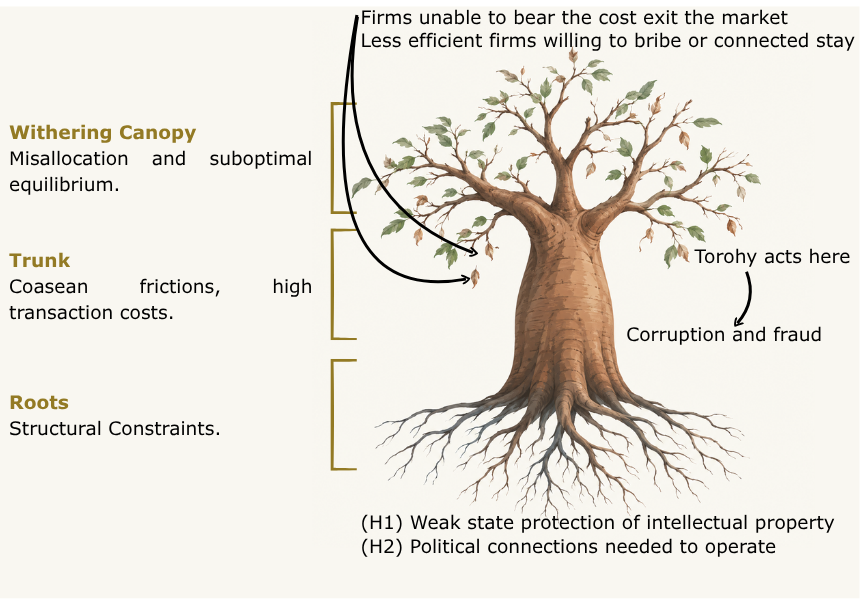
Corruption substantially raises firms' costs and when these costs become excessive, some firms may choose to exit the market. The protection premium is paid by firms willing to pay for official state protection of their assets or activities. In this context, some firms are exposed to considerable fraud risk, primarily due to bias in the allocation of public contracts. Firms respond by appointing a senior public official as an intermediary with the public administration. The country therefore faces two coexisting regimes. One in which allocation follows connections, enabling inefficient firms to survive, and one in which allocation follows willingness to pay, allowing efficient firms to succeed but forcing them to bear the costs of corruption.
A bribe does not disappear within the economy because it constitutes a transfer from one party to another, the cost for social welfare comes from the resulting distortions. While those arrangements are better than no production, a deadweight loss remains for the economy, the incentives for corruption persist, and firms are more likely to resort to fraud behaviour themselves (bribery, tax evasion, bid rigging) as a way of coping. Frictions appear in the Coasean bargaining process between administration and a firm, intellectual property is not protected, property rights are not well defined, and firms are willing to bribe the public administration to obtain protection. Since bribe agreements cannot be reliably enforced through the courts, they rely on private enforcement (relationships, reputation, threats of retaliation), which keeps transaction costs high. As a result, firms that are not necessarily cost-efficient remain in the market, leading the economy to a suboptimal equilibrium with weak technical progress.
Cost-efficient firms are willing to pay for state protection if that payment secures efficient public enforcement. They are also willing to bear theliability cost of corruption in order to remove corrupt competitors from the market. If they face a risk of being overridden by a competitor's act of corruption, cost-efficient firms will effectively pay up to the cost of the law enforcement official procedure, which caps the amount a bribe can reach.
By implementing Torohy, the Malagasy government will raise the cost of bribery and fraud, but only if a culture of reporting follows. The tool must be complemented by communication campaigns targeted at the public officials most exposed to bribery. The government also needs to show greater efficiency in protecting private assets and in law enforcement against fraud. The practice of appointing a senior public official as an intermediary should also be discontinued.
Structural Constraints
The Malagasy economy suffers from an institutional failure that leads to a misallocation of resources among firms. Competition is reduced, and inefficient firms stay in the market while some efficient ones exit. This state is due to failed binding constraints of the Coase theorem, friction appears in the process and illegal behaviour is the answer.
The problem cannot be resolved if the roots of the economy are not fixed first. Those roots represent the structural constraints of the economy. Corruption is fueled by the roots of the economy, first a weak state protection of intellectual property and private assets. In an economy where intellectual property isn’t properly protected by the government companies aren’t willing to operate. Foreign investors are less willing to enter an economy where intellectual property is poorly protected. The literature suggests that foreign direct investment is higher where protection is stronger, Mansfield, E. (1994). A further issue that arises when operating or starting a business is the appointment of a political figure or administrative handler who links with local authorities. This can result in increased costs for the company, but the advantage gained from such connections can be a key factor in the company's competitive advantage over unconnected firms. The latter can result in significant capture by elites.
Conclusion
Two regimes coexist, one where allocation follows connections and inefficient firms survive, and another where it follows willingness to pay, efficient firms win but bear the cost of corruption. The willingness to eradicate the culture of corruption by providing a tool to the general population is a first step toward greater economic development. But when the roots are rotten with a weak state of law and the necessity of political networking still remain, the fruits of the baobab cannot prosper. Without treatment of the roots the tool implementation can even lead to a worse situation, where the elites, in a weak state will leverage the benefits of small denouncements into a disproportionate law response. There are still many questions to be answered, including how the tool is effectively going to be implemented? How sanctions will be imposed? Will civil servants actually use the tool? The central question is whether the government is willing to address the underlying issues and treat the roots of the problem.
M.H